Take a moment and read the linked article and then give your input as to the impact (on the business) of this type of policy. Does it benefit the company more than it harms the company? Is it only appropriate for certain types of companies (consumer packaged goods? automobile companies? clothing companies? grocery stores?)? What do you see as the upside for the company that extends this benefit to customers? What are potential downsides? How do you weigh them against each other?
Showing posts with label policy. Show all posts
Wednesday, October 16, 2013
Return Whatever, Whenever?
Should a customer be able to return any item that he or she has purchased? And should this "right" be a "forever" right? This is a question posed in an article about LL Bean. The store famously allows returns from customers at any point....for any reason. In their words, they have " an astonishingly lenient return policy."
Monday, October 24, 2011
Adieu Foie Gras
Foie gras will become illegal in California in July 2012, so eat up now....if you so choose. Foie gras, a delicacy popularized in France but eaten by many who desire luxury in fine dining, is a dish made from the liver of ducks and geese that has been specially fattened.
The liver is made fatty by a forced feeding (gavage) of the ducks and geese in the last 12-15 days of their lives, by inserting a tube down their throat which forces the food (corn mash) directly into their stomach, thereby fattening up the liver. This tube is said to not hurt the animal.
Foie gras has been banned in certain areas before, notably in 2006 in Chicago. The ban there lasted two years before protestors had it brought back on the market.
Do you think the California ban of 2012 will stand? Would you support the ban or are you against banning foie gras?
The liver is made fatty by a forced feeding (gavage) of the ducks and geese in the last 12-15 days of their lives, by inserting a tube down their throat which forces the food (corn mash) directly into their stomach, thereby fattening up the liver. This tube is said to not hurt the animal.
Foie gras has been banned in certain areas before, notably in 2006 in Chicago. The ban there lasted two years before protestors had it brought back on the market.
Do you think the California ban of 2012 will stand? Would you support the ban or are you against banning foie gras?
Tuesday, October 11, 2011
Fat tax
"On Saturday, Denmark became the first country in the world to introduce a "fat tax," surcharge on unhealthy foods that are high in saturated fat in hopes of curbing bad eating habits."
Everything that contains more than 2.3% saturated fat (bacon, butter, pizza, oil, red meat, cheese, milk etc.) will have an extra $1.28 per pound ($2.87 per kilogram) of saturated fat added to the price. They are doing this in order to fight the rate of obesity in their country and to encourage healthier eating. The money that is raised by this additional tax will be used to educate consumers and other obesity-fighting measures.
What are your thoughts on this? Is it right for the government to try to mandate healthier eating? Is it fat that is the culprit? What about taxing sugars and refined carbohydrates as well (or instead)? Do you think that other countries will follow?
Economist Steve Sexton says that instead of taxing food that is fat, we should tax people who are fat. He lays out a way for doctors to report to the government who is fat and who is not (allowing for genetic per-disposition) and then levying a tax on those individuals. Thoughts on this?
Sunday, October 2, 2011
Is that meal "all natural?"
Marketers put many words on labels that form an instant connection with the consumer. "Wholesome," "Healthy," and "Natural" are some of them. There is much controversy (read that as "lawsuits") in the food labeling world regarding the use of the term "natural." What does it mean to you? All of these bottles of Wesson Oil are labeled "All Natural" (it is in the banner, above the type of oil).
The truth though, is that approximately 75% of corn and 95% of soybeans in the United States are genetically modified (GMOs). This then leads to the oil that results from that corn or soybeans to be GMO as well. Is this natural? Maybe so.
Some of you are familiar with the bottled drink known as "Skinnygirl Margarita." Until recently it was sold in Whole Foods, but in September was pulled off the shelves due to a claim that is contained an ingredient that is "unnatural," sodium benzoate, which is a common (although synthesized in a lab) food preservative. Sodium benzoate is in a large majority of preserved foods and drinks.
What in the heck is natural?? Does anyone know? Does the FDA have a definition for it and do they regulate the use of that word? Um, no. They have largely declined to define the term. "With the few precious dollars the FDA has, we largely choose to focus on topics that affect public safety. The 'natural' issue doesn't. That's not to say it's not important, but we frankly have more pressing issues to deal with."
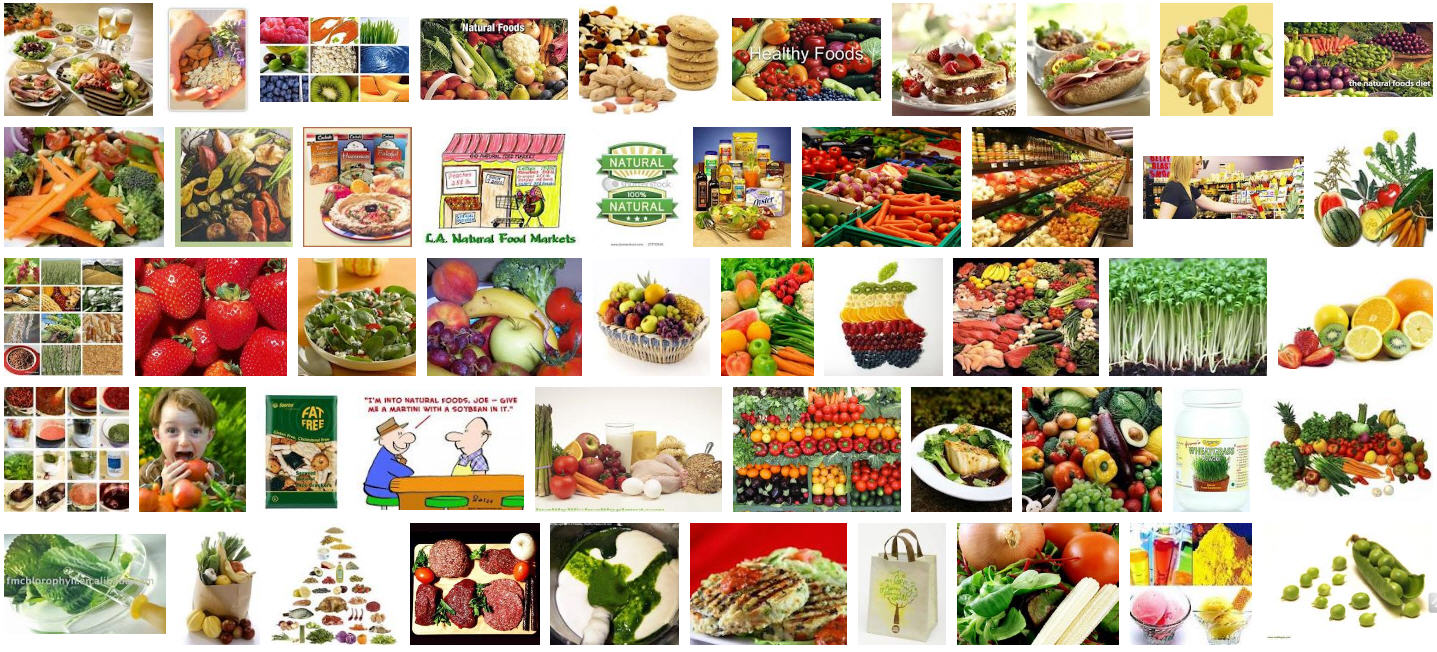
When I type "natural food" into google images, I get the following images:
To me, this means that most people think of fresh fruits and vegetables as natural. But does that preclude other foods or drinks from being in that category as well? Are we misinforming our consumers if we label something as "natural," since we don't have a hard and fast rule on just what that means?
The truth though, is that approximately 75% of corn and 95% of soybeans in the United States are genetically modified (GMOs). This then leads to the oil that results from that corn or soybeans to be GMO as well. Is this natural? Maybe so.
Some of you are familiar with the bottled drink known as "Skinnygirl Margarita." Until recently it was sold in Whole Foods, but in September was pulled off the shelves due to a claim that is contained an ingredient that is "unnatural," sodium benzoate, which is a common (although synthesized in a lab) food preservative. Sodium benzoate is in a large majority of preserved foods and drinks.
What in the heck is natural?? Does anyone know? Does the FDA have a definition for it and do they regulate the use of that word? Um, no. They have largely declined to define the term. "With the few precious dollars the FDA has, we largely choose to focus on topics that affect public safety. The 'natural' issue doesn't. That's not to say it's not important, but we frankly have more pressing issues to deal with."
When I type "natural food" into google images, I get the following images:
To me, this means that most people think of fresh fruits and vegetables as natural. But does that preclude other foods or drinks from being in that category as well? Are we misinforming our consumers if we label something as "natural," since we don't have a hard and fast rule on just what that means?
Tuesday, September 13, 2011
Sharks May Now Keep Their Fins
Living in San Diego, you're probably familiar with news of sharks in the area. Just two weeks ago there were at least two to three shark sightings just off the coast of Mission Beach. There's something scary about seeing shark fins in the water, but after all, they *do* live out there. When we, humans, choose to swim, dive, paddleboard, surf, etc. in the ocean we're actually invading their home. That said, I prefer that they keep their distance from me and I promise to not bother them.
This week there is good news for all sharks on the west coast of the United States. The California Senate passed a bill that enacts a ban "on the sale, trade, possession and distribution of shark fins."
"Washington was the first West Coast state to pass similar legislation in May followed by Oregon in early August. West Coast legislation comes on the heels of related bills passed in Hawaii, Commonwealth of Northern Mariana Islands, and Guam."
Have any of your eaten shark fin soup? It is quite a delicacy in some parts of the world. Read the above linked article and let me know what you think about the new (potential) legislation (Governor Brown must sign the bill by Oct. 8th in order for it to become law).
This week there is good news for all sharks on the west coast of the United States. The California Senate passed a bill that enacts a ban "on the sale, trade, possession and distribution of shark fins."
"Washington was the first West Coast state to pass similar legislation in May followed by Oregon in early August. West Coast legislation comes on the heels of related bills passed in Hawaii, Commonwealth of Northern Mariana Islands, and Guam."
Have any of your eaten shark fin soup? It is quite a delicacy in some parts of the world. Read the above linked article and let me know what you think about the new (potential) legislation (Governor Brown must sign the bill by Oct. 8th in order for it to become law).
Tuesday, April 26, 2011
TED - Next Generation and Bionic Fight
I was recently sent two great pieces by a couple of your classmates.
Imelda sent me this article that talks about the pros and cons of GMOs (genetically modified organisms). It features Joel Salatin, the farmer from Virginia that many of you liked and respected from the Food Inc. video.
Nick sent me this short video. It is an eleven year old (future leader, I think!) who has a sure sense of self and a real idea of what he wants in his food and what he doesn't want.
As the first article states, "The argument continues. Some say GMOs are the best hope for the world's food shortage, while others say they are our worst nightmare."
What is your take?
Imelda sent me this article that talks about the pros and cons of GMOs (genetically modified organisms). It features Joel Salatin, the farmer from Virginia that many of you liked and respected from the Food Inc. video.
Nick sent me this short video. It is an eleven year old (future leader, I think!) who has a sure sense of self and a real idea of what he wants in his food and what he doesn't want.
As the first article states, "The argument continues. Some say GMOs are the best hope for the world's food shortage, while others say they are our worst nightmare."
What is your take?
Friday, March 25, 2011
Consumer Protection or Endangerment?
We have talked in class about whether there should be laws regarding what products can be produced. If there is a market, should anything/everything be able to be produced and sold?
There is currently controversy over whether apps alerting consumers to police checkpoints should be allowed. "Locate Speed traps, speed cameras, DUI/DWI check points, red light cameras, active police vehicles and police enforcement areas." is how FuzzAlert advertises themselves. PhantomAlert is another company producing similar software. They claim that their product is to discourage drivers from drinking and driving. Four U.S. Senators have called for Apple to pull the apps from their devices, saying that alerting drunk drivers to the fact that police have a checkpoint set up is potentially dangerous for other people on the road who could be victims of the drunk drivers.
What do you think? Should we have software that alerts consumers to police checkpoints, speed cameras, etc.?
There is currently controversy over whether apps alerting consumers to police checkpoints should be allowed. "Locate Speed traps, speed cameras, DUI/DWI check points, red light cameras, active police vehicles and police enforcement areas." is how FuzzAlert advertises themselves. PhantomAlert is another company producing similar software. They claim that their product is to discourage drivers from drinking and driving. Four U.S. Senators have called for Apple to pull the apps from their devices, saying that alerting drunk drivers to the fact that police have a checkpoint set up is potentially dangerous for other people on the road who could be victims of the drunk drivers.
What do you think? Should we have software that alerts consumers to police checkpoints, speed cameras, etc.?
Thursday, February 3, 2011
Smoke Gets in My Eyes
Tara J. brought this to my attention this morning. Thank you!! This is an excellent example of a marketing and public policy issue.
New York City Council bans smoking in public parks and beaches. NYC isn't the first city to enact a ban like this although it is the largest city to do so.
It would certainly cut down on pollution (cigarette butts, air pollution, second hand smoke) but it would also cut into what some people consider a "right" in the great outdoors.
What are your thoughts on it?
New York City Council bans smoking in public parks and beaches. NYC isn't the first city to enact a ban like this although it is the largest city to do so.
It would certainly cut down on pollution (cigarette butts, air pollution, second hand smoke) but it would also cut into what some people consider a "right" in the great outdoors.
What are your thoughts on it?
Wednesday, February 2, 2011
Eat Less
The USDA recommends that Americans eat less. That is understandable, considering the fact that we have gotten *so* used to eating more. And more. And more. We can't continue at this pace. It isn't good for us, but it's what we do...because it is what the restaurants offer us. And let's be honest. We all go to restaurants, right? Who has time to cook at home anymore??
Does anyone need the "All American Jack?" Which, with small fries and drink add up to 1400 calories? Honestly, it is $4.99 for the whole meal. How can you NOT eat it at that price?
What favors are we doing the American public?
I think the following quote is....oh I can't find the right word for it. Funny? Ridiculous? Honest? Sad?
"The bottom line is we're in the business of making money, and we make money off of what we sell," said Beth Mansfield, spokeswoman for CKE Restaurants Inc., which owns the Carl's Jr. and Hardee's chains. "If we wanted to listen to the food police and sell nuts and berries and tofu burgers, we wouldn't make any money and we'd be out of business."
What would be your suggestions to the restaurants?
Does anyone need the "All American Jack?" Which, with small fries and drink add up to 1400 calories? Honestly, it is $4.99 for the whole meal. How can you NOT eat it at that price?
What favors are we doing the American public?
I think the following quote is....oh I can't find the right word for it. Funny? Ridiculous? Honest? Sad?
"The bottom line is we're in the business of making money, and we make money off of what we sell," said Beth Mansfield, spokeswoman for CKE Restaurants Inc., which owns the Carl's Jr. and Hardee's chains. "If we wanted to listen to the food police and sell nuts and berries and tofu burgers, we wouldn't make any money and we'd be out of business."
What would be your suggestions to the restaurants?
Subscribe to:
Posts (Atom)